Preventing Winter Sunscald on Young Betty Magnolia Trunks
If a magnolia is hardy to the zone on its tag, why would a sunny January afternoon split its bark? Most people assume cold kills trees and sun only helps them. We see the opposite on young single-trunk Betty trees: the trunk is fine on the coldest night and cracked after the first bright, still day that follows.
Tag hardiness describes the buds, wood and roots. It says little about a thin-barked trunk facing south. We'll walk you through what the damage looks like, how to separate it from canker and mower injury, which remedies hold up, then the short routine we use until the bark toughens.
This is a different problem from the frozen flower buds we cover elsewhere. Lose a bloom year and the tree recovers. Lose a strip of bark on a single trunk and the tree carries the scar for good.
Vertical Cracks on the Sunny Side of the Trunk
The most obvious sign is a long, narrow crack running up and down the trunk. Here is where to look and what it means.
Where the Cracks Show Up
Check the south and southwest faces first, then the west. The crack usually runs with the grain of the trunk, often starting near the soil line or at the first fork. The bark on the shaded north side stays smooth and intact, and that contrast is the giveaway.
The cracks look dry and tight at first, like a seam in a leather boot. By midsummer the edges often curl slightly as the tree tries to wall off the wound.
Why a Sunny Day Does It
On a clear winter afternoon, low sun warms the trunk's bark well above the air temperature. The cells under the bark wake up a little. When the sun drops behind a fence, a house or the horizon, that same bark cools in minutes. The swing from warm to frozen is the injury, not the cold itself.
That is why a Betty rated for zones 4-8 can still crack in zone 5 or 6. The rating tells you how low the tree can go. It does not tell you how fast the trunk can change temperature.
Snow makes it worse. Bright ground reflects extra light onto the trunk from below, so a tree in an open lawn takes more than one tucked against a shrub bed.
Does Betty Magnolia Bark Really Scald in Winter?
Let's weigh the claim honestly. Sunscald gets blamed for a lot of dead bark, and not all of it is deserved.
The case for it is real. Thin, smooth bark on a young single stem, a south-facing exposure and sharp day-night swings are exactly the conditions where scald is documented on other smooth-barked trees. Betty is hardy to zone 4b as a plant, but a young trunk in that climate takes the most extreme swings of any part of it.
The case against is just as real. Nobody has published bark trials specific to Betty. We have no tested number for how thin is too thin, and no study that ranks Betty against its siblings. Anyone who gives you a precise rule here is guessing.
Our verdict: scald is plausible and worth a modest defense, but it is not the cause of every ugly patch. Canker, mower strikes, voles, a tight tag and drought stress all produce damage that looks similar by April. Before you buy a roll of wrap, find out what you actually have.
The location matters too. A trunk in the shade of a larger tree rarely scalds. A trunk in a bright, open site, the kind that gives the best flowering in full sun, is the one at risk. If you are still choosing a spot, our guide to Betty magnolia sun requirements covers the tradeoff.
Sunken Patches on a Young Betty Magnolia Trunk
Not all damage is a crack. In spring, many people find a flat, dull or flaking area and wonder what happened. This is how to read it.
What Scald Damage Looks Like
Scalded bark turns dull, slightly sunken and a little dry compared with the glossy bark around it. It may flake or peel in sheets. The patch is elongated up and down the trunk and sits on the sun-facing side. The edges are fairly clean and the damage stops at a distinct line.
How to Tell It From Canker and Mower Injury
Use position and shape as your first test, then scratch lightly.
- Mower or trimmer damage sits low, usually within a hand or two of the soil. It often wraps around the trunk or shows a ragged gouge, and it can appear on any side.
- Canker tends to sit around a branch union or a pruning wound. It can ooze, show dark sunken rings, or have a patchy, irregular outline. It does not care which way the trunk faces.
- Scald hugs the south or west face, and the surrounding bark on the shaded side is fine.
- Vole or rodent chewing leaves visible tooth marks and bare wood, often under snow or mulch.
Scratch a tiny spot with a fingernail near the edge of the patch. Green and moist means living tissue. Brown and dry means dead. If you cannot tell, read our guide to Betty magnolia pests, diseases and common problems before you cut anything.
Leave the damaged area alone. Do not paint it with wound dressing and do not pry off loose bark. The tree seals the edges on its own, and cutting into live tissue enlarges the wound.
Why Young Betty Magnolia Trunks Split on Cold Nights
Cracking does not always happen in the afternoon. The second cause shows up after dark, and it explains why a trunk can fail even with no sun on it that day.
Young Betty trunks are thin-barked and smooth. There is little corky insulation between the living layer and the air. The wood in a young stem also holds a lot of water, so it responds quickly when the temperature drops.
On a clear, still night, heat radiates straight off the trunk into open sky. The outer bark cools and contracts faster than the wood beneath it. That mismatch can pop a vertical split, sometimes with an audible crack. The split often follows a spot already weakened by sun the day before.
The result is a two-stage injury. Sun warms the trunk, the evening freeze shocks it, and the split opens where the stress is highest. One cycle might do nothing. A dozen in a row is where the damage happens.
Wet soil and a late, soft flush of growth from heavy fall feeding make the trunk less ready. We cover timing in our fertilizing guide. A tree that goes into winter well watered but not overfed is better prepared.
One of the most common questions we get is whether a split means the tree is finished. Usually not. Betty is a small tree and bark wounds on a young stem often close over, though a large open crack deserves a closer look.
Wraps, Whitewash and Shade: What the Evidence Supports
Three remedies get recommended constantly. Here is how each holds up, given that nobody has tested them on Betty specifically.
| Remedy | What it does | Our verdict |
|---|---|---|
| Light-colored tree wrap | Reflects sun and buffers temperature swings on the trunk | Worth doing for the first winters, if applied and removed correctly |
| White latex paint | Reflects light and keeps the bark closer to air temperature | Reasonable alternative to wrap, thin coat only |
| Shade board on the south side | Blocks direct sun and sheltering light reflected off snow | Works, but is awkward and looks it |
Tree Wrap
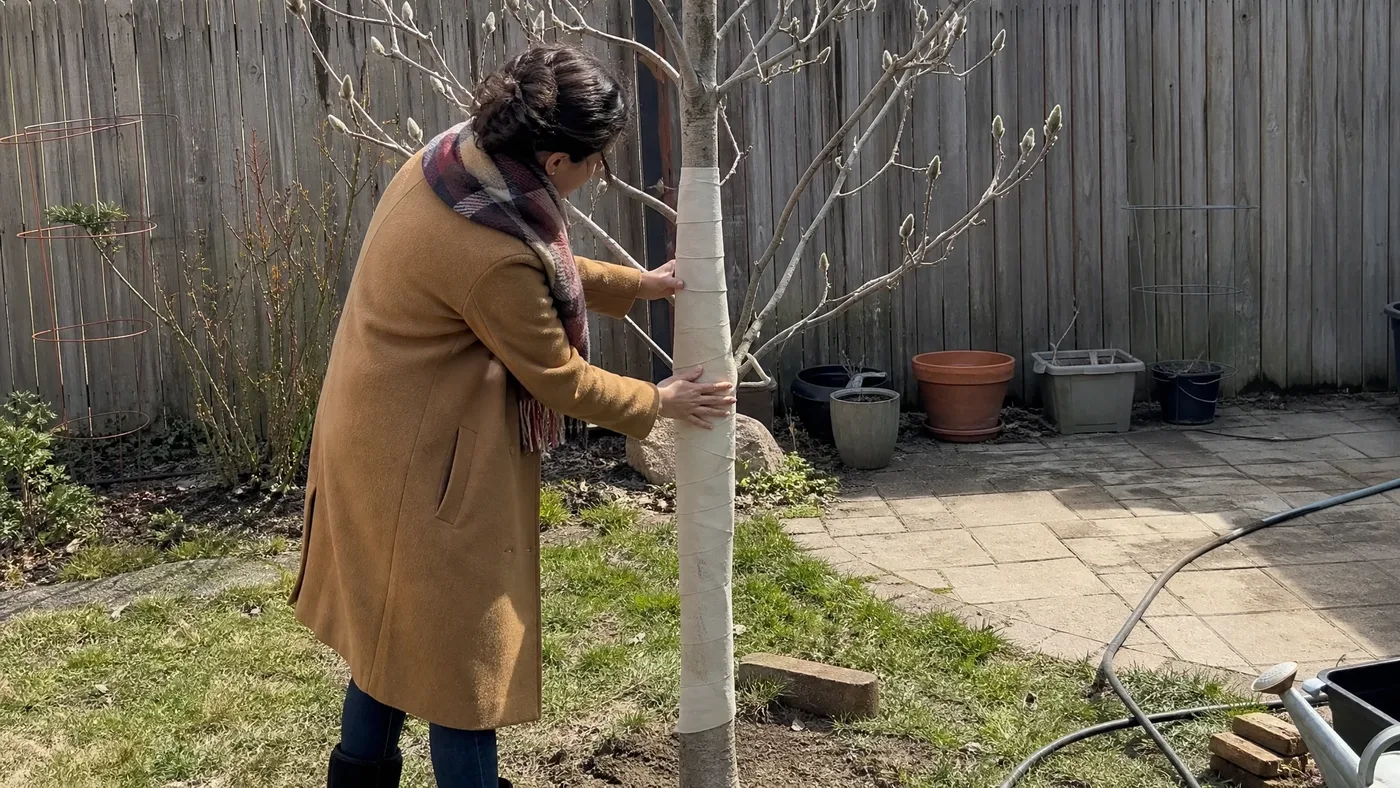
A light-colored spiral or paper wrap is the standard answer, and the logic holds. It shades the bark and slows the swing. The risk is that it holds moisture and shelters insects if left on. Put it on in November, take it off in spring, and never leave it on through summer.
White Paint
Diluted white interior latex paint does the same job without the moisture trap. Keep it to a thin coat on the sun side. Skip oil-based paint and anything with additives you cannot name. Many people consider it a bit ugly, but a Betty is only trunk-visible for a few years.
A Shade Board
A strip of plywood or a cardboard sleeve staked on the south side blocks direct sun best. It is the cheapest option. It is also the one most likely to blow over, so stake it firmly.
The common advice to wrap every tree every year, forever, is not supported. Protect the young trunk and then stop.
Protecting Betty Magnolia Until the Bark Thickens
Here is the short routine we use. It takes about ten minutes per tree and works with either wrap or paint.
- In early November, after leaf drop, check the trunk for cracks, flaking or sunken patches. Note which side they are on.
- Water the root zone well if the soil is dry, so the tree enters winter hydrated. Our watering guide shows how deep to soak.
- Wrap the trunk from the soil line upward to the first main branches, overlapping each turn, or brush on the thin white coat, covering the south and west faces at minimum.
- Pull mulch back from the trunk so a mulch ring does not hold moisture against the bark.
- In late March or early April, before the mid-April bloom, remove the wrap and look at the bark again.
Our young single-trunk Betty trees are grown to be inspected like this, and we're glad to answer questions about trunk orientation before you plant.
When to Stop
Watch the bark, not the calendar. When the trunk starts to look rougher and slightly darker, with fine texture replacing the smooth gloss, it has developed more insulation. For a tree that tops out at 10 to 15 feet, that happens sooner than on a big shade tree, but no source gives a year count, so go by what you see. Your local extension service can tell you how long to keep wrapping in your climate.
If you train Betty as one stem, our single-trunk guide explains how the form affects the trunk. Shrub-form Betty, with several stems, rarely needs any of this.
What Betty Magnolia Needs Each November
Here is the evidence-backed version. In November, inspect the trunk, water if dry, pull mulch back, and wrap or paint the south and west sides of any young single trunk. Remove the wrap in spring. When the bark roughens, stop.
Betty Magnolia
Nursery-grown Betty Magnolia in sizes from 1 Gallon Shrub, shipped to your door.
From $80.55
Shop Now →You can safely skip wound dressing, year-round wrapping, and any protection on multi-stem or mature plants. The sunscald risk is real but modest, and the remedy is cheap. As a small grower, we care about this because a lost trunk means starting over, and we would rather help you keep the Betty you planted. We're a small business that grows and sells top-quality magnolias on our own farms.