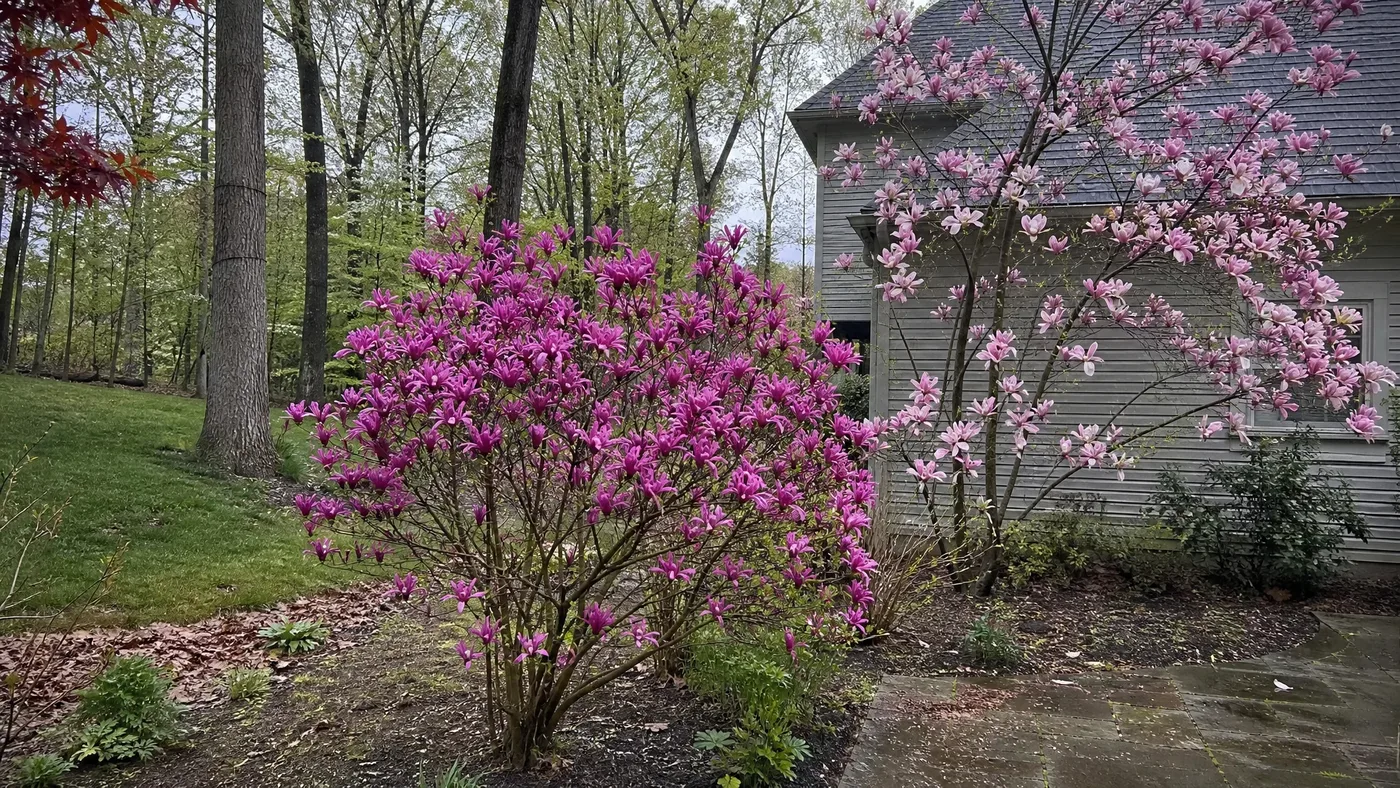
Betty Magnolia vs Saucer and Tulip Magnolias Compared
You bought a tag that said magnolia, planted it near the patio, and a few years later the tree is far bigger than the space you planned for. Or you are standing in the nursery aisle right now with Betty, a saucer magnolia and something labeled tulip magnolia in front of you, and the tags are not helping. Common names get shared loosely, and the size gap between these plants is large.
Betty Magnolia tops out around 10 to 15 feet in most references. A saucer magnolia can reach 33. Put the bigger tree in the wrong spot and it crowds the wall, shades the bed, and loses its flowers to frost more often than Betty does.
Below, you'll find out all about how Betty Magnolia differs from saucer and tulip magnolias, including size and root demands, overall shape, flower form and color, late frost risk, and which yard suits which tree.
Betty Magnolia Beside a Saucer Magnolia's Sprawl
Size is where mix-ups cost people the most, so we start there. The gap is not a few feet, and it comes from how each plant is built.
What the Published Numbers Say
The University of Minnesota Extension describes Betty as growing 10 to 15 feet high and 8 to 12 feet wide. It is a shrubby, slow-growing plant that reaches about 15 feet by 12 feet. Other references range from about 8 to 13 feet up to 15 to 20 feet (University of Illinois), so we tell customers to plan for the upper end.
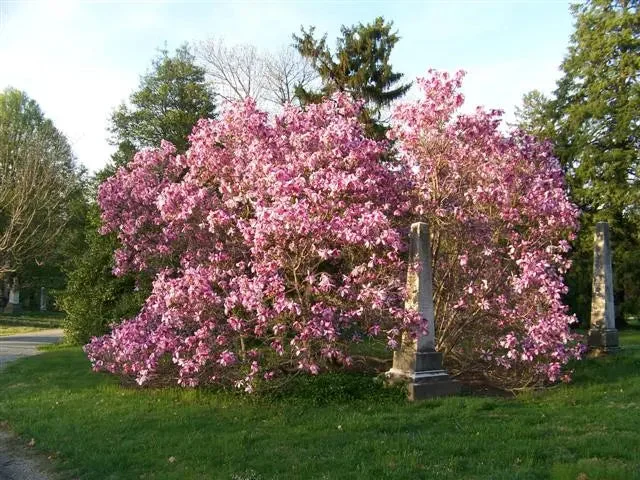
Saucer magnolia (Magnolia x soulangeana) reaches 15 to 33 feet tall and 15 to 25 feet wide, at a medium growth rate. The smallest saucer is already as tall as a large Betty, and the widest is roughly double Betty's spread.
Why the Saucer Sprawls
The saucer is multi-trunked, or has its main branches low on the trunk, in a rounded, spreading habit. Each low trunk is another leader that adds length and girth every year, so the crown widens as it rises.
Betty is a Little Girl series hybrid of lily magnolia ('Nigra') and star magnolia ('Rosea'). Saucer magnolia is not one of its parents. Those parents give a dense, shrubby plant that grows slowly, which is why our size and growth rate guide talks about decades, not a few seasons.
Why Saucer Roots Want a Bigger Yard
What happens underground follows what happens above it. We know of no published root measurements for either plant, so the reasoning below is a rule of thumb, not a figure.
A Bigger Crown Pulls More Water
A canopy 15 to 25 feet wide has far more leaf surface than one 8 to 12 feet wide, and every leaf loses water on a warm afternoon. The roots have to supply that loss, so a large tree needs a larger area of undisturbed, moist soil than Betty does. Crowd it with a driveway on one side and a foundation on the other, and the roots run short in the first dry summer.
Soil Chemistry Matters More for the Saucer
Saucer magnolia suits acid soil only, below pH 6.0. Betty suits acid or neutral soil, a slightly wider window. In soil that is too alkaline, magnolias struggle to take up iron, and the new leaves turn yellow between the veins. That yellowing is called chlorosis. Our soil guide for Betty covers testing and fixing it.
Where That Leaves Placement
One of the most common questions we get is how close to the house a magnolia can go. For Betty, closer than most people expect. For a saucer, the honest answer is that you should give it the kind of room you would give a shade tree. Magnolia roots are thick and slow to recover from damage, so keep trenches and utility lines away from either one.
Tulip Magnolia Reaches Up While Betty Magnolia Stays Round
Tulip magnolia is the hardest of the three to pin down, because the name is used for more than one plant. Treat this section as a guide to shape, not to exact numbers.
Why We Avoid Giving Tulip Magnolia a Size
Our sources give no figures for a plant sold simply as tulip magnolia, and we would rather say so than guess. Some tags use the name for lily magnolia, one of Betty's parents, and others for the cup-flowered saucer. What we can say is that tulip-type magnolias are sold as taller, more upright trees, and that you should ask for the botanical name before you buy.
Upright Versus Round
An upright tree puts its growth into height and casts shade over whatever sits beneath it. Betty does the opposite. With a height of 10 to 15 feet and a width of 8 to 12 feet, its outline is close to a rounded mound, slightly taller than wide.
That shape has practical effects. A round, dense plant can sit beside a wall or at a corner and read as a shrub. An upright tree needs space overhead and will outgrow a bed under a window. We see this mix-up often with tags that say only "magnolia", and the tall tree ends up in the bed meant for the round one.
Flower Shape and Color Across the Three
You can often tell these plants apart from the sidewalk in bloom, if you know what to look for.
Betty's Layered, Purplish Pink Flowers
The University of Illinois describes Betty's large purplish pink flowers with 12 to 18 tepals. Tepals are the petal-like parts magnolias have in place of separate petals and sepals. That many tepals gives a full, layered flower, not a single plain cup. Betty also reblooms in summer, which the larger magnolias are not known to do.
The Saucer's Cup
Saucer magnolia flowers are gigantic and cup-shaped, opening before the leaves. A saucer in full bloom looks like a tree holding hundreds of goblets against bare branches. The tulip name comes from that kind of upright, cupped flower, which is why the labels get tangled.
Telling Betty From Its Closer Look-Alikes
Flower size alone will not separate Betty from every magnolia. If your actual confusion is between Betty and Jane, our Betty and Jane comparison handles that pair, and the bloom time and color guide goes deeper on Betty's own color.
Why Betty Magnolia Buds Escape Late Frost
Timing is the least visible difference and, for many yards, the most important one. It decides whether you see flowers at all in a cold spring.
How Frost Damages a Magnolia Bloom
Magnolias set their flower buds the season before, and buds swell during any mild spell in late winter. Once the tepals open, the tissue is soft and holds a lot of water. A hard freeze browns it within a day, and the display is gone for the year. The tree itself usually recovers. The earlier a bud wakes, the more likely a freeze follows.
Where Betty Gains Two to Four Weeks
Cornell reports that Betty flowers 2 to 4 weeks later than star magnolia and saucer magnolia, reducing the potential of frost damage. Missouri Extension gives a smaller gap, saying the Little Girl cultivars generally bloom one to two weeks later than star magnolia cultivars. The two sources use different comparisons and different climates, so expect the gap to shift with your region and year.
Cornell gives Betty's window as mid-April to early May. NC State, for its part, warns that saucer flowers open in late winter or mid-spring and tells growers to plant late-flowering cultivars to avoid severe frost damage. Betty is one of those.
What This Does Not Promise
Later is not frost-proof. A hard freeze in late April can still catch Betty with its buds showing color. If you are in a frost pocket, a low spot where cold air settles, you will still lose some springs. Our advice is to cover a plant on a freezing night and to expect better odds, not a guarantee.
Three Magnolias, Three Different Yards
With size, roots, shape, flowers and frost covered, here is how we match each tree to a site. The table below summarizes our picks, and the paragraphs after it explain the reasoning.
| Site | Our pick | Reason |
|---|---|---|
| Bed under a window or beside an entry | Betty Magnolia | Rounded, 10 to 15 feet, minimal pruning |
| Open lawn with room on every side | Saucer magnolia | Spreads 15 to 25 feet wide |
| Cold, frost-prone yard | Betty Magnolia | Blooms weeks later |
| Zone 9 | Saucer magnolia | Betty is listed for zones 4 to 8, saucer for 4a to 9b |
| Tight side yard with limited headroom | Betty Magnolia | Stays below the saucer's height range |
Where We Would Choose Betty
For beds, foundations, patios and any yard where late freezes are a regular event, Betty is our choice. It needs minimal pruning, which matters because the usual advice to keep a saucer small by pruning does not hold up well. A tree that wants to spread will keep trying, and you will be cutting it back every year. See our buying guide for sizes.
When a Saucer Earns Its Space
If you have an open lawn and want a large flowering tree, a saucer magnolia earns its space. In zone 9, where Betty is not listed, it is also the more realistic option. We often see saucers planted beside doorways and then fought for years, so choose the bigger tree only if you will let it be big.
Betty Magnolia Is the Tree for the Small Bed
Betty is the compact, rounded, later-blooming one at 10 to 15 feet. Saucer magnolia is the broad, early, large one at up to 33 feet, and tulip magnolia is a name you should never accept without a botanical name behind it. Before you buy, ask one thing: can you show me the cultivar name and mature width on this tag? If the answer is vague, the tree is probably bigger than you want. The tree we would not squeeze into a small bed is the saucer magnolia.
Betty Magnolia
Nursery-grown Betty Magnolia in sizes from 1 Gallon Shrub, shipped to your door.
From $80.55
Shop Now →On our farms we grow Betty in full sun, in acid to neutral soil, with enough room between plants for the crown to stay round, which is the same set of conditions we recommend for your yard.